
itemprop=”articleBody description text”> BlackBerry does not want to die.
itemprop=”articleBody description text”> It’s been hurting for a long time. The company formerly known as Research in Motion has gone from being the top smartphone maker in the world-one of the first devices Whose merited the term-is a community Laughingstock. Part Of That blame can be laid on the iPhone: It changed the industry BlackBerry helped found, and the company has been trying to figure out a way forward ever since-not always successfully. Its profitability has taken a topsy-turvy ride, jobs and services have been cut, and its marketshare has plummeted.
itemprop=”articleBody description text”> So what do you do when your brand is being mocked and analysts are shouting your demise? You focus on your customers, not your critics, and you keep moving. This is the meat, BlackBerry DECIDED to become a patron of the arts.
Rebranding the advertorial
itemprop=”articleBody description text”> When you buy a smartphone, you have your traditional feature checklist, but above all you want to know that it can support you in your life. You want to be able to communicate, share, and to play. You want a digital companion as much as a device. Apple uses apps (and those who use them) to make this point. Microsoft captures celebrities’ daily routines. But when you’re on the ropes, it’s not enough to ape another company’s style. You have to reintroduce users to your brand, and you must do so in a way That does not feel forced or contrived.
itemprop=”articleBody description text”> BlackBerry’s Keep Moving project has similar hallmarks is its Competitors: It uses celebrities. It Incorporates BlackBerry apps and hardware. There’s a video, and advertorial content abounds. But the project does not feel like an ad. It’s a showcase. An invitation. It says, “Hello, world. Come play with us. “The project has so far paired three artists-Alicia Keys, Robert Rodriguez, and Neil Gaiman-With Their fans to create pieces using social media and BlackBerry 10
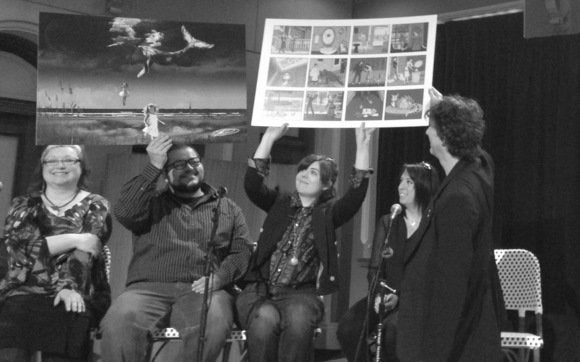 The Keep Moving project challenged three artists, Including author Neil Gaiman (right), the Collaborate With Their fans. Gaiman wrote stories inspired by fans’ tweets, Which were then illustrated by other fans.
itemprop=”articleBody description text”> TechHive covered the launch of Neil Gaiman’s effort in March Gaiman prompted his followers on Twitter with questions about each month of the year, then used the results to create short stories for each month , these stories were then illustrated by artists around the globe.
Advertisement itemprop=”articleBody description as art
itemprop=”articleBody description text”> As a follower of Gaiman’s Twitter feed, I watched much of the original conversation unfold on February 4, not really knowing the origin of the project. Gaiman has done Twitter-sourced projects in the past, dry as 8in8, his venture with wife Amanda Palmer and friends Ben Folds and Damian Kulash, it was an experiment to write and record an eight-song album in eight hours, based off the Twitter responses . (Their final count was six songs in 12 hours-still no easy feat) Having spent much of That April day on a plane, I never personally responded to any of the calendar prompts, but found myself dipping into the well of the calendar hashtags read the replies of others around the globe. “An anonymous Mother’s Day gift,” they read, in response to the question “What’s the weirdest gift you’ve ever been given in May?” The tweet Concluded, “Think about that for a moment.” ;
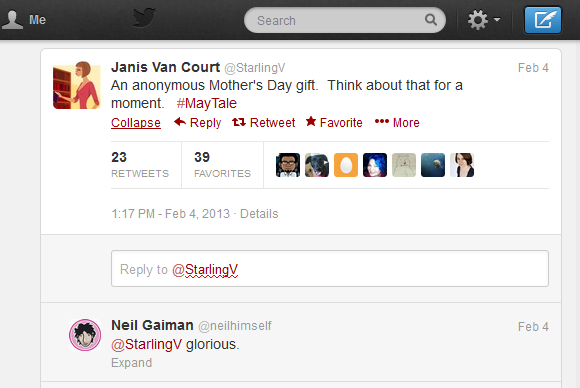
itemprop=”articleBody description text”> I did think. And so did Gaiman; That tweet and eleven others Became the source material for A Calendar of Tales, the end result of Which is viewable online in its entirety. It’s a beautiful, haunting, hilarious piece of work, bylined “By Neil Gaiman and You.” BlackBerry has no prominent place in the header-it instead hides tastefully off to the side, with only a small logo on the left to Indicate the company had a hand in the result.
itemprop=”articleBody description text”> BlackBerry’s launch party for A Calendar of Tales, which I had the pleasure of attending, was equally humble. I came, expecting to be shuttled into a room with a couple hundred journalists and listen to your BlackBerry press Representatives preach about the strength of the platform, with a quick appearance by Gaiman. Instead, I found myself in a room with Fewer than 30 people, most of whom were collaborators and Lucky Calendar Gaiman Twitter followers who had won a spot via email. Calendar of Tales artwork lined the small room at the Cambridge Multicultural Center, while Gaiman’s video diaries played in the rear corner.
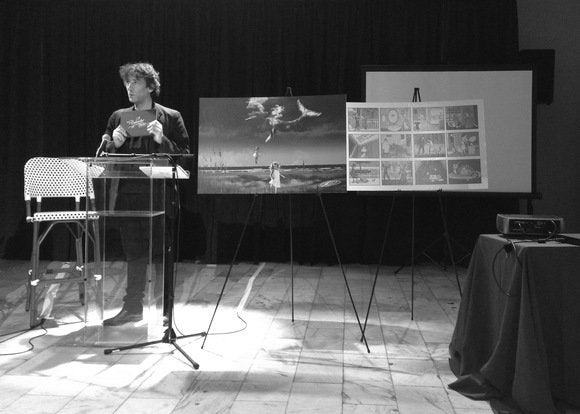 Gaiman read several of the Tales aloud at the launch event, illustrated Their companions standing nearby.
itemprop=”articleBody description text”> And as I looked at the paintings, drinking a raspberry lime rickey out of a wine glass and listening to Gaiman joke with bystanders in the background, I Realized I had not been invited to a press briefing at all. The event was a celebration of the work, and the few BlackBerry Representatives there spoke only of Their admiration for Gaiman and his collaborators. No leading questions about how essential his BlackBerry Z10 was to the process. Not a hint of forced product evangelism. Just respect for the process.
itemprop=”articleBody description text”> That’s the beauty of this advertising campaign: It does not feel like a campaign at all. BlackBerry is appealing both the users it’s lost, as well as Those it never had in the first place, but not by force-feeding the public with commercials about how great its products are-instead, the company supports exciting projects created with BlackBerry devices.
itemprop=”articleBody description text”> The press team has somehow managed a brilliant feat: Associating the BlackBerry name with the arts. And by inviting artists to Collaborate With Their followers, BlackBerry has found a natural way to release this message out into the wild. It does not need to spend millions on commercials That say, “I’m Neil Gaiman, and I’m a BlackBerry user” when it can spend far less to fund an art project and have thousands of people vitally interested in its result ( and later on, perhaps in a BlackBerry device).
The future of BlackBerry
itemprop=”articleBody description text”> The Keep Moving project alone is not going to save BlackBerry. As we’ve seen from its Competitors, the company needs strong hardware, software, and a great app ecosystem to survive. But message is almost as important in this game of phones, and the BlackBerry is doing some fantastic brand building with this campaign.
 Serenity Caldwell
 Associate Editor, TechHive 
Serenity has been writing and talking and tinkering with Apple products since she was old enough to double-click. In her spare time, she sketches, writes, acts, sings, and wears an assortment of hats.
More by Serenity Caldwell
Subscribe to the Best of TechHive Newsletter
Thank you for sharing this page.
Sorry! There was an error emailing this page


No comments:
Post a Comment